
Soft Skills 
Professional Interpersonal Skills: Why are they important in business?
People are constantly communicating. However, do we communicate effectively?
What soft skills do we require to communicate effectively and quickly ( Costigan 2016), especially for business professionals today? Communication skills can be divided into hard and soft skills, also known as interpersonal or people skills.
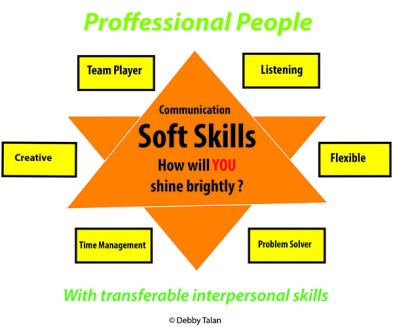
Soft skills often relate to a person’s emotional intelligence, such as their traits, their language and social graces, which characterize how their relationships with others will often be determined. Interpersonal “soft skills are a highly transferable asset that will help you to thrive in any environment”(Skills You Need, 2016). These qualities therefore are very important and highly desirable, and may ultimately determine your success as a business professional.
Cenere et al. (2015) mention that “The economic landscape now requires all business professionals – regardless of occupation, industry or sector – to develop their communications skills” and that “Communication is about empowerment“. Therefore as professionals we should desire to be heard and recognized!
You Tube video: by Debby Talan

How will you be successful and achieve your goals? How will others perceive you? What desired soft skills are needed to communicate and interact effectively within the workplace with your customers, boss and co-workers? How will you get your work done in a timely, organized manner?
I really enjoyed reading about what McKay discussed on what she considers to be important soft skills, such as: writing, verbal communication, active listening, problem solving, critical thinking, flexibility and adaptability (About, 2016).
Robles (2012) discuss the ‘Executive Perceptions of the Top 10 Soft Skills needed in Today’s Workplace’, where executives indicated that the top two most important soft skills needed in today’s workplace are integrity and communication. I agree with Robles.
To conclude, successful and effective professionals need to continue developing and demonstrating a high level of interpersonal soft skills in the workplace today.
References
Cenere, P, Gill, R, Lawson, C, Lewis, M 2015, Communication skills for business professionals, Cambridge University Press, Port Melbourne, Vic.
Costigan, L 2016, Introduction to communication concepts in a professional context, lecture notes distributed in the course COMM11003 Communication in Professional Contexts T1, CQUniversity, Bundaberg, 7 March.
DebsDesigns21, 2016, YouTube: Communication Soft Skills, viewed 1 April 2016, https://youtu.be/UtZs_8E0-s0
LinkedIn, 2016, Profile: Dawn Rosenberg McKay, viewed 2 April 2016, https://www.linkedin.com/in/dawn-rosenberg-mckay-9bb15464
Robles, M 2012, ‘Executive Perceptions of the Top 10 Soft Skills Needed in Today’s Workplace’, Business Communication Quarterly, 75(4) pp. 453-465.
Rosenberg-McKay, D 2016, About: career planning, soft skills, viewed 2 April 2016, http://careerplanning.about.com/od/importantskills/a/soft-skills.hm
Skills You Need, 2016 , viewed 28 March 2016, http://www.skillsyouneed.com
Technology
in Communication
How has technology impacted communication? How has technology influenced how I communicate?
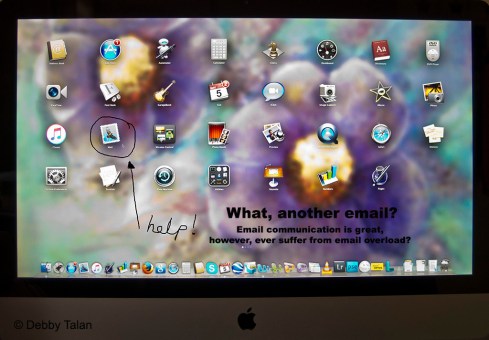
Love it or despise it!
Technology has impacted communication. What devices do you use? How many emails do you send and receive daily to communicate with people?
Technology skills are essential and equally important for the business professional, and for most people in today’s society. However, knowing how to use digital devices and their software can be very challenging. Technology devices give us many choices for sending, receiving and viewing communication messages. Costigan (2016) states “An effective communicator must choose which one will have the desired response and will be best received by an audience”.
Think about and plan your message, context and content, and what channel you will select for the most effective communication to your audience. Channels such as email, SMS, web pages, You Tube, Blogs, Social Media sites and video conferencing all have their own strengths and weaknesses. Selecting the appropriate writing style, transmission method and channel can make all the difference to the overall power of that particular communication message. The visual presentation is also very powerful and can make a huge impact! (Costigan, 2016).
Adair (2009) comments that industry and commerce today have almost been taken over by presentation from public speaking skills. I agree with Adair, as business professionals need to consider the importance of visual communication along with their digital technology skills.

Email is my preferred way for communication as it is quick, convenient and cost effective. Email has revolutionized communication of the modern world. Technology advancements have “enabled speedy cross-location and international communication” comments Cenere et al. (2015).
Kozik and Slivova’s (2014) article back this up, commenting, “one of the most widespread electronic communication tool is email communication”. They also suggest avoiding misinterpretation by the recipient, and how important it is to use “NETIQUETTE” (new rules for electronic communication) in the writing and content of email communication.
Coles (2016) also has some etiquette suggestions at ‘The Huffington Post’ http://www.huffingtonpost.com/linda-coles/email-etiquette-time-to-r_b_9818610.html.
Love it or despise it? Emails and technology communications are here to stay!
Short and humerus You Tube video by the ‘Entrepreneur’ on email etiquette.
References
Adair, J 2009, Effective communication: the most important management skill of all, Pan Books, London. UK.
Cenere, P, Gill, R, Lawson, C, Lewis, M 2015, Communication skills for business professionals, Cambridge University Press, Port Melbourne, Vic.
Coles, L 2016, ‘Email etiquette – time to review yours’, The Huffington Post, 6 February, viewed 7 May 2016, http://www.huffingtonpost.com/linda-coles/email-etiquette-time-to-r_b_9818610.html.
Costigan, L 2016, Introduction to communication concepts in a professional context, lecture notes distributed in the course COMM11003 Communication in Professional Contexts T1, CQUniversity, Bundaberg, 7 March.
Entrepreneur, 2016 YouTube: Everything you need to know about office email, viewed 7 May 2016, etiquettehttps://youtu.be/Dl6Hsw7ojYs.
Google, 2016, Free images of email logos, viewed 7 May 2016, http://www.goggle.com.
Google, 2016, Free images of arrow lines, viewed 7 may 2016, http://www.google.com.
Kozik, T & Slivova, J 2014, ‘Netiquette in electronic communication’, International Journal of Engineering Pedagogy, vol.4, issue 3, pp.67-70.
 Public Speaking
What makes a good public speaker?
Costigan (2016) comments “in a technological age, much emphasis has been placed on using technology to communicate”. Today in our modern society, technology plays a very important role for everyone, and especially for public speakers.
To be a good and successful public speaker, choosing the correct technology medium, along with an interesting and encapsulating content is highly desirable. A speaker will keep their audience well engaged throughout their speech with a presentation that is empowering and passionate. The principles of being clear and concise, informative and credible should always be considered for any communicator (Costigan, 2016).
I consider Jane Caro to be an excellent communicator. Jane is a very skilled, versatile professional presenter and public speaker. Wall Media (2016) comment that Jane “is highly skilled at pitching her message”. All the communication rules still apply to public speaking. “Be clear, be simple, be vivid”, states Adair (2009).
View an example of Jane speaking publicly about her book released in 2013, ‘Plain-speaking Jane’ during a video recorded interview conducted by Boffin Books.
A good public speaker will practice and rehearse their speech many times before the presentation. Whilst public speaking can often be uncomfortable, Cenere et al. (2015) state “the skill of public speaking can be developed over time through lots of practice”. Sharpening up of such skills and being energized, regardless of the setting, can make a big difference to your overall speech presentation.
Decoske & White (2010) also suggest paying attention to three key areas – “Delivery, structure and style”, for good communication to others. With technology often used by public speakers to deliver their message, they should also ensure their presentation is visually appealing.
View my power point mini movie presentation titled ‘Debby’s Top Tips for Public Speaking’. Note: (At the moment there are some technical issues with the sound on this video which I am trying to rectify)
And…..for those of you who really love public speaking, check out the short video on the ‘2015 World Championship of Public Speaking- Mohammed Qahtani’ from Toastmasters International !
References
Adair, J 2009, Effective communication: the most important management skill of all, Pan Books, London. UK.
A Research Guide: top tips for public speaking, viewed 14 May 2016, http://www.aresearchguide.com/3tips.html
Cenere, P, Gill, R, Lawson, C, Lewis, M 2015, Communication skills for business professionals, Cambridge University Press, Port Melbourne, Vic.
Costigan, L 2016, Introduction to communication concepts in a professional context, lecture notes distributed in the course COMM11003 Communication in Professional Contexts T1, CQUniversity, Bundaberg, 7 March.
Decoske, MA, White, SJ 2010,’Success skills: public speaking revisited delivery structure and style’, American Journal of Health-system Pharmacy, 67(15), pp.1225-1227.
Entrepreneur Magazine: Top ten public speaking tips, viewed 14 May 2016, https://www.entrepreneur.com/article/230079
Google: Images of public speakers, viewed 14 May 2016, https://google.com
Toastmasters: viewed 14 May 2016, https://www.toastmasters.org/Resources/Public-Speaking-Tips
Wall Media: Jane Caro, viewed 14 May 2016, http://wallmedia.com.au/jane-caro/
Non-Verbal Communication
What are the different types of non-verbal communication. How can non-verbal communication make or break a speech?
This Blog will look at some of the non-verbal (body language) components of communication and how important they are.
Non-verbal communication occurs constantly, is very powerful, and is often used separately to the spoken word. Eye contact, body posture, tone and volume of voice, facial expressions, and movement gestures are several non-verbal aspects that are most often noticed whether words are included or not ( Costigan, 2016).
Someone rolling their eyes or scratching their head relates to personal non-verbal communication, where as a cultural form may relate to the way people greet one another. Clothing and jewellery often make a non-verbal statement as well.
When the non-verbal and verbal components (in particular the tone of the voice) combine, they form three key components of communication. However, they must work harmoniously together. Cenere et al. (2015) expand on this, commenting that it is “how the words are said”, “how they are presented” and the “body language” that are very important for a successful communicator.

Costigan (2016) states, “you are never, not communicating”, as others are constantly watching us. Phutela (2015) hold the same view, commenting that both the verbal and non-verbal forms of communication is a process of sharing information and ideas.
The non-verbal communication is the silent form used to grab the audience’s attention, or during and exploitation of a message. Highly recognized public figures will often use non-verbal messages. These non-verbal functions can “compliment, regulate, substitute for, or accent a verbal message” states Phutela (2015). This is often how a speech can be a MAKE or BREAK for the speaker! Such speeches leave a lasting impression on your audience.
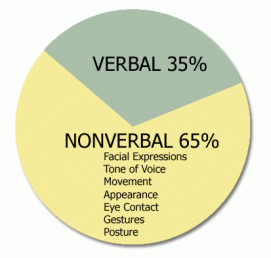
That being said, the non-verbal components or body language is therefore the utmost importance for a successful speaker. “The basic system for communication is the human body” states Adair (2009).
Remember, “communication is about empowerment. Be heard. Be recognized” Cenere et al. (2015).
Verbal communication will definitely impact your speech!
References
Adair, J 2009, Effective communication: the most important management skill of all, Pan Books, London. UK.
Cenere, P, Gill, R, Lawson, C, Lewis, M 2015, Communication skills for business professionals, Cambridge University Press, Port Melbourne, Vic.
Costigan, L 2016, Introduction to communication concepts in a professional context, lecture notes distributed in the course COMM11003 Communication in Professional Contexts T1, CQUniversity, Bundaberg, 7 March.
Google: Images of public speakers, viewed 14 May 2016, https://google.com
Phutela, D 2015, ‘The importance of non-verbal communication’, IUP Journal of Soft Skills, vol.IX, no. 4, pp. 43-49.
 Debby Talan