Business Entity: Flow Hive
The digital footprint of the Australian business Flow Hive; an analysis, evaluation and recommendations project – https://www.honeyflow.com/
References:
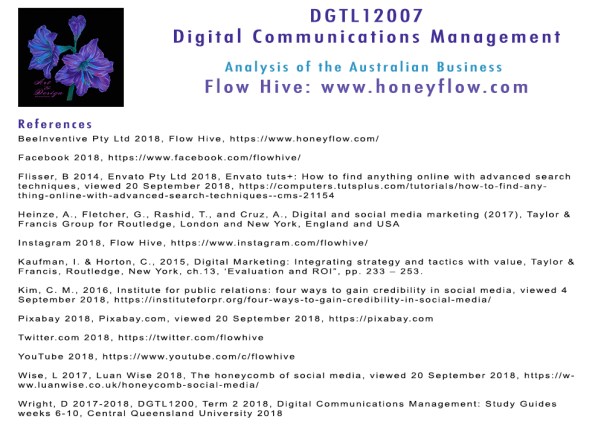

The digital footprint of the Australian business Flow Hive; an analysis, evaluation and recommendations project – https://www.honeyflow.com/
References:
Reference
Unitag 2018, Unitag: Offline to online tags manager, viewed 7 September 2018, https://www.unitag.io/features
RSS is short for “Really Simple Syndication” states Collins (Collins, J 2018). So, what are they, and, are they important to your business?
If you subscribe to RSS feeds you can potentially save some time, as you don’t have to check every day to view what has been updated on sites that you follow, similar to newspaper subscriptions. They are “simple text files” that “allow subscribers to see content” not long after being updated (Collins, J 2018). The user subscribes on sites that offer an RSS feed or Subscribe button to click on, which is usually orange. As a subscriber, if and when that site you are following updates, you receive notification of this to your email address.
If you own or publish information on a website or blog for example, then an RSS feed or Subscribe button could be useful to notify your subscribers of your update. It could also benefit you, when you subscribe, so you can receive updates on information posted by others as well.
Currently, there seems to be several issues with RSS feeds on some WordPress accounts, as commented by users on WordPress “RSS feeds not working anymore” (WordPress.org 2018). One reason could be that RSS feeds may only be available features with some free templates, or on paid WordPress subscription accounts.
As my WordPress account is only a free subscription, the Podcast settings configurations are not available on my account. The Podcast audio has therefore been uploaded to my Soundcloud account, with a link embedded and able to view by clicking on the link below the image, seen at the top of this page (WordPress.com, 2018).
Alternatively, check out my blog post on ‘Importance of Social Media Credibility’ to listen directly to the Podcast audio, or to read the Podcast transcript.
OR – Click this link to listen to my podcast on Soundcloud here: https://soundcloud.com/user-524503737/d-talan-file-6-9-18-1-12-41-pm
References
Collins, J 2018, Lifewire: What everyone should know about RSS feeds, viewed 1 September 2018, https://www.lifewire.com/rss-101-3482781
WordPress 2018, WordPress.org: RSS feed not working anymore, viewed 1 September 2018, https://wordpress.org/support/topic/rss-feed-not-working-anymore-5/
WordPress 2018, WordPress.com: Podcasting, viewed 6 September 2018, https://en.support.wordpress.com/audio/podcasting/
There are many benefits of having a LinkedIn account as it provides great opportunities for people to promote and showcase themselves, to make their online digital presence known. With LinkedIn being popular, and one of the biggest social media platforms to date, practicing Artists should have a LinkedIn profile to maintain their business relationships and connections.
LinkedIn offers interactions and connections with online networks of businesses, professionals, communities and groups, as well as fellow Artists 24/7 (Zimmerman, J & Ng, D 2015).
Zimmerman & Ng (Zimmerman, J & Ng, D 2015) suggest several reasons why you need to be on LinkedIn:
Hemant (Hemant, B 2017), on the other hand comments on the disadvantages of a LinkedIn account, such as:
In Austin’s (Austin, H 2018) online tutorial ‘How to use LinkedIn for beginners – 7 profile tips 2018’, it is worth mentioning the top seven profile tips for creating your LinkedIn account. These are:
References
Austin, H 2018, How to use LinkedIn for beginners – 7 LinkedIn profile tips 2018, viewed 1 September 2018, https://youtu.be/_kwqqtpprrE
Hemant, B 2017, Quora: What are the pros and cons of having a LinkedIn account?, viewed 1 September 2018, https://www.quora.com/What-are-the-pros-and-cons-of-having-a-LinkedIn-account
Loyd, T 2014, Pixabay.com 2018, viewed 6 September 2018, https://pixabay.com/en/linkedin-online-success-business-400850/
Zimmerman, J & Ng, D 2015, Dummies: Social media marketing, the benefits of using LinkedIn, viewed 1 September 2018, https://www.dummies.com/business/marketing/social-media-marketing/the-benefits-of-using-linkedin/
Depending on which device you are viewing my blog on, if you are unable to see the image above to click on so you can hear the audio of my Podcast on ‘Social Credibility’, you can click this link: https://soundcloud.com/user-524503737/d-talan-file-6-9-18-1-12-41-pm
Alternatively, you may prefer to read the written transcript below.
Hi Everyone.
Today, I am going to discuss why social credibility is so important for online communities and professional artists.
Social online credibility is extremely important for social media platforms, their environments, and our business. With our audience engaging and communicating with our organisations through social media on a daily basis, if we do not interact effectively and credibly with the public, then it could have serious consequences for our business.
Personal interaction on line with our community helps us to connect to our audience, and, to build and form great relationships. From such great relationships, our audience builds trust and credibility for our brand. Therefore, when connecting and interacting with our audience, using concepts towards forming those relationships will contribute immensely to a personable feel. Whenever you create a post, advert or campaign for example, it is important to remember your concepts, along with your content to protect your businesses credibility.
That content you create is equally important when sharing with your audience, as your information needs to illustrate that you are competent. This also displays that your business has expertise, and importance in its specific area.
Kim (Kim, C. M. 2016) comments another “area that influences public’s” perceptions of credibility in social media” is whether your brand “invites conversation”. This means that your postings are carefully crafted to invite, engage, and sustain conversation, that enables you and your audience to comment, respond, and listen. Maintaining good conversation interaction, also helps establish that your brand is authentic and trustworthy. Therefore, it is not good for businesses to ignore such comments, nor take too long with responding, as this often breaks down communications. Communication breakdown has the ability to damage your brands reputation and credibility, and, ultimately your success!
Furthermore, we can see how credibility and trustworthiness really go hand in hand when it comes to social media management and etiquette. Without trust, your audience may not continue their relationship with you. This could be very costly for you and your business, which may take some considerable time, to regain that trust and connection with your community.
Developing, establishing and continually engaging regularly with your social media audience, really requires careful consideration to incorporate the many significant factors for a successful online relationship. Businesses can greatly benefit from using social media effectively and efficiently, to gain important, stronger audience perceptions of their trust and credibility (Kim, C. M., 2016).
As an artist, communicating authentically and reliably, will really benefit to your overall organisation’s success and that of a professional business owner.
References
Kim, C. M., 2016, Institute for public relations: four ways to gain credibility in social media, viewed 4 September 2018, https://instituteforpr.org/four-ways-to-gain-credibility-in-social-media/
Soundcloud.com 2018, Debby Talan 2018: Social credibility, https://soundcloud.com/user-524503737/d-talan-file-6-9-18-1-12-41-pm
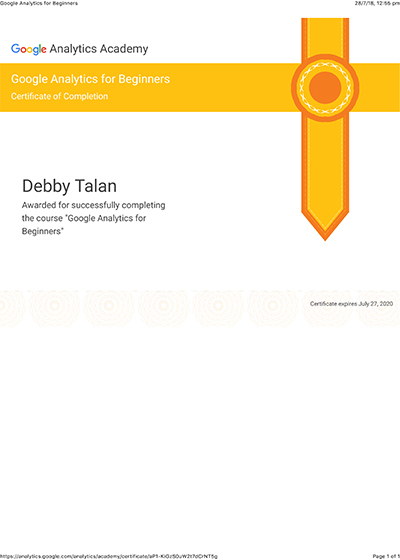
View my Google Analytics Certificate for beginners at: Google Analytics for Beginners
References
Google 2018, Google Analytics Academy: Google Analytics for beginners, viewed 28 July 2018, https://analytics.google.com/analytics/academy/
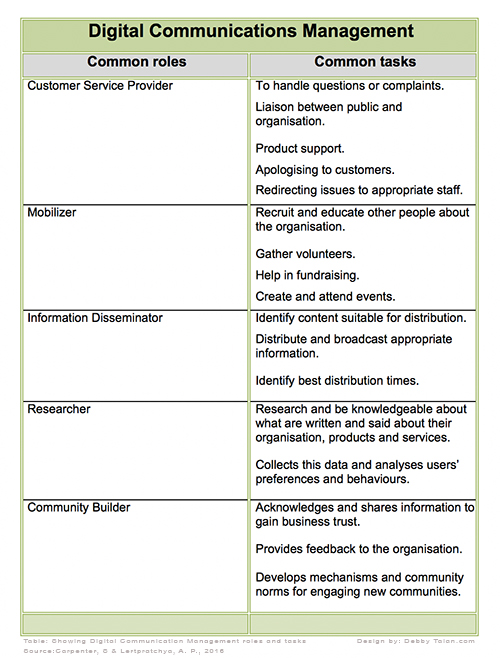
With the ever-increasing popularity of social media platforms and the growth in engagement of users, there has also been a large increase in management position roles for social media communicators. Effective social communicators have the power to influence, and therefore make a huge impact with business customer relationships and their organisations dynamics. For example, occupation professionals from areas such as marketing, public relations, business and journalism have been engaging in roles of digital competitive communication managers for many years now, by using their skills gained from their professions, whilst increasing their skills in social media (Carpenter, S & Lertpratchya, A. P., 2016).
Wright (Wright, D 2018) comments “Design a digital communications strategy with the end user in mind. The end user is your primary focus”. Digital communicators need to be constantly aware of their ever-changing audience, their needs and desires to effectively communicate and engage with their target audience. Therefore, the role and tasks of the digital communicator is a very important one in today’s social media platforms and communities. And, credibility of content must be consistent and reliable, with regular updates.
However, it is important to note that in smaller and sole trading businesses such as Artists, most of these digital communication management roles and tasks will be performed by only the person themselves.
References
Carpenter, S & Lertpratchya A.P., 2016, ‘Social media communicator roles: A scale’, February 2016, Social Media + Society, vol.1, no.11, SAGE Journals, http://journals.sagepub.com/doi/pdf/10.1177/2056305116632778
Wright, D 2018, DGTL12007 Digital Communications Management: Digital communications strategies, Study Guide 6, Central Queensland University 2018.
View some very interesting mobile phone statistics by Best Computer Science Degrees: http://www.bestcomputersciencedegrees.com/mobile/

References
Best Computer Science Degrees.com, The Rise of the mobile, viewed 4 September 2018, http://www.bestcomputersciencedegrees.com/mobile/
Pixabay, 2018, Pixabay, viewed 5 September 2018, https://pixabay.com/en/iphone-smartphone-apps-apple-inc-410311/
As an artist another way to promote your digital online self and business could be in the form of creative and informative videos. Sites such as Flickr and DeviantArt , or Vimeo and YouTube offer great free social platforms for this purpose.
Flickr enables users to “upload their own photos” (Moreau, E 2018), that can be shared with your Flickr followers and other friends.
You can view my Flickr page, to see some of my other photography and artworks here: https://www.flickr.com/people/152328257@N08/
Another example of an artists beautiful artworks posted on the social media platform of Flickr, is by Anna Wolf (Wolf, A. 2007) at: https://www.flickr.com/photos/annas_atelje/5598328437/
Alternatively, you can view Anna’s work from the image and link below:

Flickr is purely a photo sharing social platform, and many professional photographers display their images here for others interested in photography to enjoy. In this way it differs from that of Instagram, Facebook, and DeviantArt as only photos can be shared. Users profiles show a profile photo and a brief bio. Flickr can give your artistic talents great exposure to the public, by giving interesting descriptions of your photos on where and why they were taken and the inspiration behind it. Using keywords to tag your photos will also “increase your chances of your photo showing up in search results” (Moreau, E 2018).
On Flickr you can keep your images in photo collections and albums, which enables the sharing of an entire album. Statistics are shown in charts and graphs, which includes recent views of your photos and how other people are viewing your images. Comments can be made and received on the photographs. Your Flickr page can also display photographs of other images that you really like, that belong to other users. Flickr is definitely a great community to be part of to promote yourself.
DeviantArt also targets artistic creativity and promotion of oneself, however, it’s not just about photography. It is a social platform for sharing and viewing all areas of artistic creations from traditional art, to film and animation, designs, game development, digital art, photography, literature and so much more! Users can search through the many categories and keywords to find individual artists or styles and view thousands of learning videos. Becoming a DeviantArt member is free, and the platform has “over 46 million members” (DeviantArt, 2018). As a member you can create a professional looking portfolio which looks very similar to a website and give and receive critiqued feedback on your work and that of others. DeviantArt offers unlimited uploads for free, and even supports a great slideshow player.
Another great feature of DeviantArt is that you can write a journal onto your page to help attract people there, and automatic alerts are given to your followers and friends.
Instant private messages can be sent and received by users, and members can participate in “exclusive sponsored art contests’ with great prizes! (DeviantArt, 2018). DeviantArt also offers members the opportunity to sell and buy original artworks and digital prints, through a shopping cart feature. The site handles all the processes of printing, framing and shipping to customers upon sales of your artwork, and Items can be shipped to many countries worldwide.
Additionally, Vimeo and YouTube are also social media platforms that could be advantageous for promoting your business. Both sites offer video sharing (including video blogs) and are free to join, although the free subscriptions do have some limitations. For most users, a free subscription is sufficient.
Vimeo’s larger storage options and interaction tools for example, are only available with payment plans. There is no advertising on Vimeo like YouTube has. Videos range from short and brief to more in depth tutorials and films (Vimeo, 2018).
Moreau (Moreau, 2018) comments that Vimeo is “very much known specifically for creative artistry”, and therefore varying somewhat to YouTube, aiming more at professional artists. YouTube is also to date, the leading video platform with a larger audience, however, sometimes videos get lost in the crowd. Both platforms give users the opportunity to watch, share, Save to your Watch List, and comment on.
Other comparisons between Vimeo and YouTube are the different upload and storage restrictions. Vimeo’s free account videos are not as good quality as the paid subscribers and storage is only 500MB per week. YouTube on the other hand has no limit on uploads, or video quality, which is therefore more suitable for frequent video makers. There are more than 3 billion videos viewed daily on YouTube and “more than 48 hours of user-generated video content is uploaded every minute” states Moreau (Moreau, 2018). With statistics like this, an artist really should consider their video marketing and self-promoting strategies seriously.
References
Creative Commons, 2018, viewed 30 August 2018, https://creativecommons.org.au/learn/fact-sheets/attribution/
DeviantArt 2018, viewed 30 August 2018, https://welcome.deviantart.com/
Moreau, E 2018, Lifewire: What is Flickr?, viewed 28 August 2018, https://www.lifewire.com/what-is-flickr-4147535
Moreau, E 2018, Lifewire: What is Vimeo? An intro to the video sharing platform, viewed 30 August 2018, https://www.lifewire.com/what-is-vimeo-3486114
Moreau, E 2018, Lifewire: Vimeo Vs YouTube, which video sharing site is best?, viewed 30 August 2018, https://www.lifewire.com/vimeo-vs-youtube-which-is-better-3486370
Vimeo, 2018, viewed 30 August 2018, https://www.vimeo.com
Wolf, A 2007, Flickr 2018, viewed 30 august 2018, https://www.flickr.com/photos/annas_atelje/5598328437/
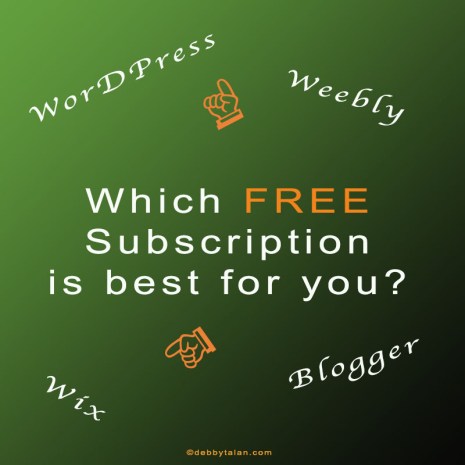
When commencing your social media business platform profiles, it is also important to be aware of the FREE website building subscription options such as WordPress, Wix, Weebly and Blogger, as you may also wish to engage in a professional blog site and website.
Comparing their features and what you actually require will depend on an individual’s and/or business’s needs, as you may want to add video, audio, a photo gallery, contact forms and even an online store. Initially you may not require all such features, however, it is well worth considering these points before beginning your website or blog. As your business grows, managing your business needs and features within the website builder needs to be as easy as possible.
WordPress offers many great free features and accessibility and is therefore a very popular website builder with its simplicity and security. It is easy to use and manage. You can choose from many of their free and customable template designs and register with your own domain name. Features include analytical statistics, responsive mobile themes (meaning your website will look good when viewed on any device), mobile apps, great support, and the opportunity to easily upgrade your service in the future. As you own your own content, managing your account offers great freedom to alter and export that content at any time. Free and open source plugins are available for use on your free WordPress website (WordPress, 2018).
WPBeginner (WPBeginner, 2018) comments “WordPress is the world’s most popular website building platform” with “over 28% of all websites on the internet are powered by WordPress”. And, what is important to note, WordPress offers two platforms, WordPress.org and WordPress.com, which are both quite different. So, it is worthwhile to check out their differences carefully.
The free Wix website builder in comparison only offers a basic free service to build your website using the customable templates. However, analytic tools, an eCommerce store, and platform hosting are not free Wix features, available only through paid subscription. With the free service you are able to build and test out your website and choose from plugin functionality apps. A custom domain name is not included in the free Wix free plan either, although your business will have a Wix site address (WPBeginner, 2018).
Weebly also offers many good template designs, and also has an easy drop-and-drag photo feature with its free basic website plan. However, if you wish to switch to another platform, Weebly is rather difficult to do this with. It is also “not an ideal solution to create a blog or run an online store” (WPBeginner, 2018). A paid Weebly service plan does offer a lot more features.
Blogger is the Google available free blogging platform, hosting it on blogspot.com. It gives users access to free analytics and the hosting service. Blogger also enables you to host contributing bloggers on your site. A blogger can “host multiple blogs with the same account name” states Karch (Karch, M 2018), with options of either a Blogger URL or a domain one. Images can be easily uploaded from your desktop by the drag-and-drop method into a chosen blogger template, and videos are easy to embed into a Blogger post. Like many other website and blogging building services, blogs can be shared on social media sites for promotion of your page or post.
Looking at and comparing the four free website builders of WordPress, Wix, Weebly and Blogger, demonstrates many opportunities to consider for promoting yourself and your business.
References
Karch, M 2018, Lifewire: Getting started with Google Blogger, viewed 28 August 2018, https://www.lifewire.com/what-is-google-blogger-1616420
Wix 2018, Free vs. premium site, viewed 28 August 2018, https://support.wix.com/en/article/free-vs-premium-site
WordPress 2018, Democratise Publishing: Our mission, viewed 28 August 2018, https://en-au.wordpress.org/about/
WPBeginner 2018, Beginner’s guide for WordPress: How to choose the best website builder in 2018 (compared), viewed 28 August 2018, https://www.wpbeginner.com/beginners-guide/how-to-choose-the-best-website-builder/
 Debby Talan